
-
 Nasa 'Flying Saucer' Test Bedevilled for Second Time by Botched Parachute9 June 2015
 -
Nasa to Test Supersonic Parachutes in 'Flying Saucer' Launch3 June 2015
-
Nasa Set for Revolutionary 'Flying Saucer' Test Flight2 June 2015
-
Nasa Delays Test Flight of 'Flying Saucer' LDSD Until Wednesday10 June 2014
- Home
- Science
- Science News
- Nasa's Flying Saucer Being Used to Test New Mars Landing Technology
Nasa's Flying Saucer Being Used to Test New Mars Landing Technology
By Indo-Asian News Service | Updated: 1 April 2015 18:17 IST
Click Here to Add Gadgets360 As A Trusted Source

Advertisement
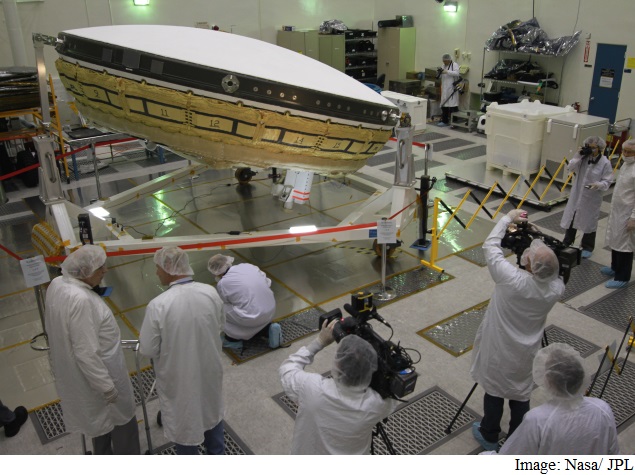
Nasa's Low-Density Supersonic Decelerator (LDSD) project will be flying a rocket-powered, saucer-shaped test vehicle into near-space from the US Navy's Pacific Missile Range Facility on Kauai, Hawaii, in June.
The LDSD crosscutting demonstration mission will test breakthrough technologies that will enable large payloads to be safely landed on the surface of Mars, or other planetary bodies with atmospheres, including the Earth, Nasa said in a statement.
The final test of LDSD technology was carried out at Jet Propulsion Laboratory, Pasadena, on Tuesday.
During the "spin table test," the 15-foot-wide, 7,000-pound test vehicle was spun up to 30rpm to check its balance. In mid-April, the vehicle will be flown to Kauai.
During the June experimental flight test, a balloon will carry the test vehicle from the naval facility to an altitude of about 120,000 feet (36km).
There it will be dropped over the Pacific and its booster rocket will kick in and carry it to 180,000 feet (55km), accelerating to Mach 4. Once in the very rarefied air high above the Pacific, the saucer will begin a series of automated tests of two breakthrough technologies.
The supersonic inflatable aerodynamic decelerator (SIAD-R) - an inflatable doughnut that increases the vehicle's size and, as a result, its drag - will be deployed at about Mach 3.8.
It will quickly slow the vehicle to Mach 2.5 where the parachute - the largest supersonic parachute ever flown - will deploy.
The upper layers of the Earth's stratosphere are the most similar environment available to match the properties of the thin atmosphere of Mars.
Comments
Get your daily dose of tech news, reviews, and insights, in under 80 characters on Gadgets 360 Turbo. Connect with fellow tech lovers on our Forum. Follow us on X, Facebook, WhatsApp, Threads and Google News for instant updates. Catch all the action on our YouTube channel.
Further reading:
Low Density Supersonic Decelerator, Nasa
Related Stories


Advertisement
Follow Us




-

04:12
Samsung Galaxy A37 Review: Camera, Gaming & Battery Tested! -
14:16
[Partner Content] OPPO F33 Pro 5G Explained: Built for the Big Moments -
05:21
Poco X8 Pro Max Review | Is This the Ultimate Budget Beast? -
04:16
OnePlus Nord 6 Review | Full Honest Review, Camera Test, Performance & Battery -
05:17
Samsung Galaxy A57 Full Review: 50MP Triple Camera & 5000mAh Battery. Worth It?
-
20 हजार रुपये सस्ता मिल रहा Google Pixel 10, यहां मिल रहा तगड़ा डिस्काउंट
-
Paytm पर कैसे छिपाएं अपनी ट्रांजेक्शन, दूसरा कोई नहीं देख पाएगा
-
Spotify ने घटाई अपने प्लान की कीमत, हुआ सबसे सस्ता म्यूजिक प्लेटफॉर्म
-
Amazon की समर सेल में OnePlus, Xiaomi और अन्य ब्रांड्स के टैबलेट्स पर 40 प्रतिशत तक डिस्काउंट
-
25 हजार सस्ता मिल रहा OnePlus का 4 कैमरों वाला फोन! धांसू डिस्काउंट ऑफर
Advertisement
Popular on Gadgets
- Samsung Galaxy S26 Ultra
- Motorola Razr Fold
- ChatGPT
- OPPO Find N6
- Mobiles Under Rs. 40,000
- Vivo X300 Ultra
- Asus Zenbook S14
- iQOO 15
- Vivo X300 Pro
- Lenovo Yoga Slim 7i Aura Edition
- iQOO 15R
- Vivo X Fold 5
- Sony PlayStation 5
- HP OmniPad 12
- OnePlus Nord CE 6 Lite
- OnePlus Pad 4
- OPPO F33 Pro 5G
- Cryptocurrency
- HP OmniBook Ultra 14 (2026)
- iPhone 17
- Eureka Forbes AP 355 Room Air Purifier
- Latest Mobile Phones
- Compare Phones
Latest Gadgets
- Vivo Y60
- Sony Xperia 1 VIII
- Itel Zeno 200
- OnePlus Nord CE 6 Lite
- OnePlus Nord CE 6
- Honor Play 70C
- Honor Play 80 Plus
- Moto G47
- Dell 14S
- Dell 16S
- Huawei MatePad Pro Max
- HP OmniPad 12
- Garmin Forerunner 170
- Garmin Forerunner 70
- Lumio Vision 9 (2026)
- Lumio Vision 7 (2026)
- Asus ROG Ally
- Nintendo Switch Lite
- Blue Star 1.5 Ton 5 Star Inverter Split AC (IA518ZXUS)
- Blue Star 1.5 Ton 3 Star Inverter Split AC (IA318ZXU)

- About Us
- Sitemaps
- Feedback
- Archives
- Contact Us
- RSS
- Advertise
- Career
- Privacy Policy
- Ethics
- Editorial Policy
- Terms & Conditions
- Complaint Redressal
Download Our Apps
Available in Hindi
© Copyright Red Pixels Ventures Limited 2026. All rights reserved.





-
 New Biosignature Method Could Transform Search for Alien Life
-
 Human Vapor OTT Release Date: When and Where to Watch it Online?
-
 Inspector Avinash Season 2 Out on OTT: Know Where to Stream This Randeep Hooda Starrer Action Thriller Series
-
 Hansal Mehta’s Khana Dil Se Now Streaming on YouTube: Know Everything About This AI-Powered Cooking Show