-
 SpaceX Falcon 9 Launches Cygnus XL for NASA ISS Resupply Mission13 April 2026
 -
NASA Astronauts Complete 7-Hour Spacewalk to Prepare ISS Power System Upgrade20 March 2026
-
NASA, SpaceX Delay ISS Mission Launch Due to Bad Weather10 February 2026
-
NASA, SpaceX Move Up Crew-12 Launch After ISS Medical Emergency30 January 2026
-
NASA Astronaut Sunita Williams Retires After 27 Years of Space Service22 January 2026
- Home
- Science
- Science News
- Nasa's Cassini Spacecraft Captures Triple Crescent Moon on Saturn
Nasa's Cassini Spacecraft Captures Triple Crescent Moon on Saturn
By NDTV Correspondent | Updated: 23 June 2015 17:12 IST
Click Here to Add Gadgets360 As A Trusted Source

Advertisement
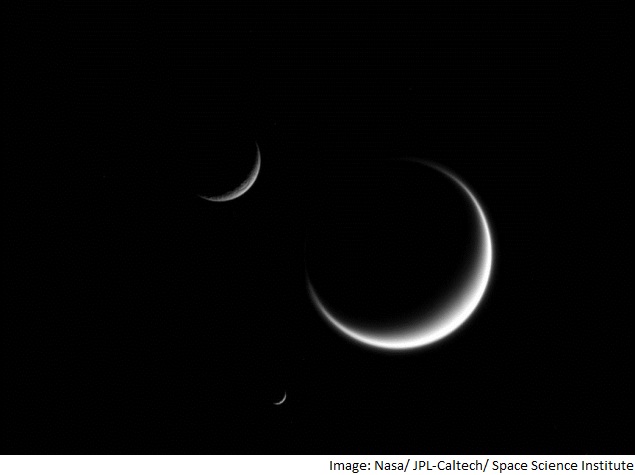
Nasa's Cassini spacecraft, on a study mission to Saturn since 1997, has captured a rare triple crescent moons sighting on Saturn.
Saturn has nine named moons and as many as 53 natural satellites in its orbit.
As the multiple moons wax and wane in light, they create a mesmerising image. Such a triple crescent moon sighting was captured by Cassini in March, but has just now been released by Nasa.
Titan, the largest moon pictured, appears a bit fuzzy due to the cloud layers. The moon in the upper left-hand side is Rhea, which has a diameter about one-third the size of Titan. Rhea appears a bit bumpy due to its ice-covered craters.
The smallest crescent moon pictured is the minute Mimas, which is around 13 times smaller than Titan, and surface irregularities can be seen due to the moon's violent history.
The photograph was taken using only visible light and a narrow-angle lens from the Cassini spacecraft. It captures what could be seen with naked eyes, if given the chance.
The view was obtained at a distance of approximately 1.2 million miles (2.0 million kilometres) from Titan. Image scale at Titan is 75 miles (121 kilometers) per pixel. Mimas was 1.9 million miles (3.1 million kilometres) away with an image scale of 11.4 miles (18.4 kilometres) per pixel. Rhea was 2.2 million miles (3.5 million kilometres) away with an image scale of 13.1 miles (21.1 kilometer) per pixel.
Written with inputs from IANS
Comments
Get your daily dose of tech news, reviews, and insights, in under 80 characters on Gadgets 360 Turbo. Connect with fellow tech lovers on our Forum. Follow us on X, Facebook, WhatsApp, Threads and Google News for instant updates. Catch all the action on our YouTube channel.
Related Stories





Advertisement
Follow Us




-

04:49
Realme 16 Review: Air Design, 7000mAh, And More | Best Phone Under 35000 In 2026? -
05:05
Goboult Mustang Racer Smartwatch Review: Should You Get This Mustang Smartwatch? -
04:58
OnePlus Nord Buds 4 Pro Review: Specs, Sound Quality, ANC, and Battery Backup Tested -
02:29
[Sponsored] Samsung Galaxy S26 Ultra First Look: AI Smartphone for Creators, Gaming & Productivity -
04:25
Vivo X200T Review - Full Camera, Gaming & Battery Test | Worth Buying?
-
Motorola Edge 70 Pro हुआ 50MP कैमरा, 6500mAh बैटरी के साथ लॉन्च, जानें
-
Oppo Find X9s हुआ 12GB RAM, 7025mAh बैटरी के साथ लॉन्च, जानें सबकुछ
-
40 हजार रुपये सस्ता मिल रहा Google Pixel 8, जानें कितना मिल रहा डिस्काउंट
-
Xiaomi ने नया कॉर्डलैस वैक्यूम क्लीनर किया लॉन्च, 2600mAh बैटरी के साथ 75 मिनट लगातार क्लीनिंग, जानें कीमत
Advertisement
Popular on Gadgets
- Samsung Galaxy Unpacked 2026
- iPhone 17 Pro Max
- ChatGPT
- iOS 26
- Laptop Under 50000
- Smartwatch Under 10000
- Apple Vision Pro
- Oneplus 12
- OnePlus Nord CE 3 Lite 5G
- iPhone 13
- Xiaomi 14 Pro
- Oppo Find N3
- Tecno Spark Go (2023)
- Realme V30
- Best Phones Under 25000
- Samsung Galaxy S24 Series
- Cryptocurrency
- iQoo 12
- Samsung Galaxy S24 Ultra
- Giottus
- Samsung Galaxy Z Flip 5
- Apple 'Scary Fast'
- Housefull 5
- GoPro Hero 12 Black Review
- Invincible Season 2
- JioGlass
- HD Ready TV
- Latest Mobile Phones
- Compare Phones
Latest Gadgets
- Honor 600
- Honor 600 Pro
- OPPO Find X9s
- OPPO Find X9s Pro
- OPPO Find X9 Ultra
- Vivo Y6t
- Redmi K90 Max
- Redmi A7 4G
- Asus ExpertBook P5 G1
- Asus ExpertBook P3 G1
- Redmi K Pad 2
- OPPO Pad Mini
- NoiseFit Diva Araya
- OPPO Watch X3 Mini
- Xiaomi TV S Mini LED 2026 (75-inch)
- Xiaomi TV S Mini LED 2026 (65-inch)
- Asus ROG Ally
- Nintendo Switch Lite
- Haier 1.6 Ton 5 Star Inverter Split AC (HSU19G-MZAID5BN-INV)
- Haier 1.6 Ton 5 Star Inverter Split AC (HSU19G-MZAIM5BN-INV)

- About Us
- Sitemaps
- Feedback
- Archives
- Contact Us
- RSS
- Advertise
- Career
- Privacy Policy
- Ethics
- Editorial Policy
- Terms & Conditions
- Complaint Redressal
Download Our Apps
Available in Hindi
© Copyright Red Pixels Ventures Limited 2026. All rights reserved.