-
 NASA Plans Nuclear-Powered Spacecraft for Skyfall Mission to Mars26 March 2026
 -
NASA’s ESCAPADE Mission to Study Space Weather Between Earth and Mars27 February 2026
-
Curiosity Rover Reconnects After Solar Conjunction, Begins Critical Organic Search on Mars6 February 2026
-
NASA’s Perseverance Makes History on Mars with Claude AI at the Helm3 February 2026
-
NASA Races to Restore Contact With MAVEN Mars Orbiter After Weeks of Silence27 January 2026
- Home
- Science
- Science News
- Isro's Mars Orbiter Mission to Look for Life Sustaining Elements on the Red Planet
Isro's Mars Orbiter Mission to Look for Life-Sustaining Elements on the Red Planet
By Indo Asian News Service | Updated: 24 September 2014 18:10 IST
Click Here to Add Gadgets360 As A Trusted Source

Advertisement
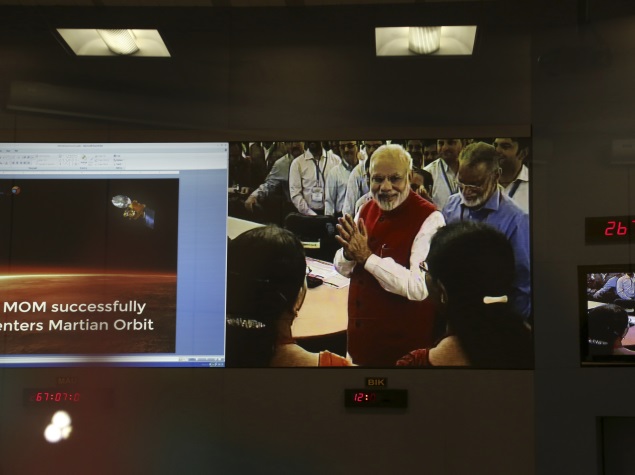
Five scientific instruments onboard the Indian spacecraft will explore Mars during the next six months in search of life-sustaining elements on the Red Planet.
"Though our spacecraft will take 77 hours or 3.2 earth days for each rotation around Mars at a distance of 500 km nearest and over 80,000 km farthest from its surface, it will conduct experiments to study its surface and rich mineral composition and scan its atmosphere for methane gas to find out if the planet can support life," a senior space official told IANS Bangalore Wednesday.
(Also see: Isro's Mangalyaan Enters Mars Orbit; India Creates History)
"The Orbiter has three solar panels for generating energy and three antennas (high, medium and lower) for radio links with earth stations and deep space networks," the official added.
The 475-kg spacecraft with the five instruments (payloads), weighing 15 kg, entered Mars' orbit earlier in the day.
First instrument - Mars Colour Camera (MCC) - will provide images of the planet's surface features and weather patterns such as dust storms.
"The MCC will also supply images of the Red Planet's two moons - Phobos and Deimos," the official said.
Second instrument - Methane Sensor (MS)- will look for the methane gas in the Martian atmosphere, as its presence may indicate whether life can be supported or sustained on the planet.
Third instrument - Mars Exosphere Neutral Composition Analyser (MENCA) - will study neutral gas atoms found in the outermost part of the Martian atmosphere.
Fourth instrument - Lyman Alpha Photometer (LAP)- will measure relative abundance of two isotopes of hydrogen to understand the process by which Mars has been losing its atmosphere and turning into a dry planet from a wet one.
Lastly, the fifth instrument - Thermal Infrared Imagery Spectrometer (TIIS) - will map the surface temperature to understand the composition and mineralogy of Mars.
Comments
Get your daily dose of tech news, reviews, and insights, in under 80 characters on Gadgets 360 Turbo. Connect with fellow tech lovers on our Forum. Follow us on X, Facebook, WhatsApp, Threads and Google News for instant updates. Catch all the action on our YouTube channel.
Related Stories



Advertisement
Follow Us




-

05:05
Goboult Mustang Racer Smartwatch Review: Should You Get This Mustang Smartwatch? -
04:58
OnePlus Nord Buds 4 Pro Review: Specs, Sound Quality, ANC, and Battery Backup Tested -
02:29
[Sponsored] Samsung Galaxy S26 Ultra First Look: AI Smartphone for Creators, Gaming & Productivity -
04:25
Vivo X200T Review - Full Camera, Gaming & Battery Test | Worth Buying? -
28:31
The Future of Productivity: Logitech's Anatoliy Polyanker On AI, Hybrid Work, And India's Tech Boom
Advertisement
Popular on Gadgets
- Samsung Galaxy Unpacked 2026
- iPhone 17 Pro Max
- ChatGPT
- iOS 26
- Laptop Under 50000
- Smartwatch Under 10000
- Apple Vision Pro
- Oneplus 12
- OnePlus Nord CE 3 Lite 5G
- iPhone 13
- Xiaomi 14 Pro
- Oppo Find N3
- Tecno Spark Go (2023)
- Realme V30
- Best Phones Under 25000
- Samsung Galaxy S24 Series
- Cryptocurrency
- iQoo 12
- Samsung Galaxy S24 Ultra
- Giottus
- Samsung Galaxy Z Flip 5
- Apple 'Scary Fast'
- Housefull 5
- GoPro Hero 12 Black Review
- Invincible Season 2
- JioGlass
- HD Ready TV
- Latest Mobile Phones
- Compare Phones
Latest Gadgets
- Nord 6
- Honor X80i
- Honor Play 80 Pro
- Redmi Note 15 SE 5G
- Redmi A7 Pro
- OPPO K15 Pro
- OPPO K15 Pro+
- Lava Bold N2 Lite
- Xiaomi Book Pro 14
- MacBook Neo
- Vivo Pad 6 Pro
- Lenovo Legion Y700 Gen 5
- boAt Valour Watch 1R
- Xiaomi Watch S5
- Xiaomi QLED TV X Pro 75
- Haier H5E Series
- Asus ROG Ally
- Nintendo Switch Lite
- Haier 1.6 Ton 5 Star Inverter Split AC (HSU19G-MZAID5BN-INV)
- Haier 1.6 Ton 5 Star Inverter Split AC (HSU19G-MZAIM5BN-INV)

- About Us
- Sitemaps
- Feedback
- Archives
- Contact Us
- RSS
- Advertise
- Career
- Privacy Policy
- Ethics
- Editorial Policy
- Terms & Conditions
- Complaint Redressal
Download Our Apps
Available in Hindi
© Copyright Red Pixels Ventures Limited 2026. All rights reserved.