-
 WhatsApp Is Finally Working on Adding Support for Android's Notification Bubbles Feature24 April 2026
 -
Google Showcases Verified Email Feature Designed to Speed Up Android App Signups23 April 2026
-
How to Send WhatsApp Message History in a Group on Android and iOS: A Step-by-Step Guide17 April 2026
-
Google's Pixel Phones Could Support Pixel Glow Notification Feature Once Again, Android 17 APK Teardown Shows17 April 2026
-
WhatsApp Working on Business Chat Filtering Feature That Could Offer Tidier Chat List: Report16 April 2026
- Home
- Others
- Others News
- Samsung Gear Fit runs RTOS instead of Android or Tizen
Samsung Gear Fit runs RTOS instead of Android or Tizen
By Hitesh Arora | Updated: 27 March 2014 16:07 IST
Click Here to Add Gadgets360 As A Trusted Source
Advertisement
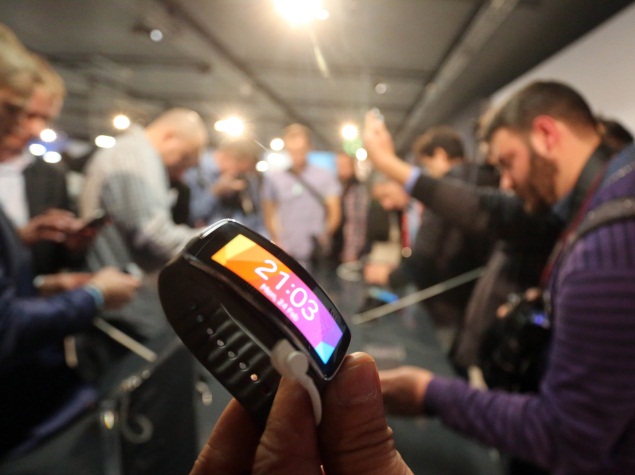
The "world's first" wearable device with a curved Super AMOLED touch display - the Samsung Gear Fit - won't be coming with either Tizen or Android OS. The Korean electronics giant has loaded its new fitness band, the Gear Fit, with a real-time operating system (RTOS) instead.
According to the company, the RTOS loaded on Gear Fit is a simpler platform that processes data significantly faster than the others.
"It's a much simpler OS, and it helps us keep the battery life three to four days whereas Gear 2 is [about] two days," Seshu Madhavapeddy, senior vice president of product and technology at Samsung Telecommunications America, told CNET.
The Samsung Gear Fit is smaller and lighter than the Gear 2 and Gear 2 Neo smartwatches, and is focused on health. The benefit of incorporating RTOS is that it allowed Samsung to utilize a smaller amount of memory and a less powerful processor on the Gear Fit.
Samsung suggests that while the RTOS is a much simpler OS, it still comes with multitasking capabilities. It uses a set of predetermined simple tasks which helps speed up the functionality and allows the Gear Fit to last three or four days off of a single charge.
The downside of the simpler RTOS is that it does not allow developers to create 3rd party apps for the Gear Fit directly. Instead, developers can use a specific SDK to customise their Android apps to work with it, sending notifications to the band.
Samsung on Thursday launched Gear Fit, Gear 2 and Gear 2 Neo in India, alongside the Galaxy S5. The Gear Fit features a 1.84-inch Super AMOLED display with a 432 x 128 pixel resolution. It comes with a pedometer, heart rate monitor, and a sleep monitor. Other built-in functions include a fitness app, exercise mode, stopwatch, timer, schedule, smart relay, media controller. Additionally, the users will get active notification alerts for SMS, calls, e-mail and apps on the Gear Fit.
A 210mAh battery powers the Samsung Gear Fit, which gives a typical usage of 3 to 4 days and up to 5 days with low usage. The device measures in at 23.4 x 57.4 x 11.95 mm (body only) and weighs 27 grams. Comments
Get your daily dose of tech news, reviews, and insights, in under 80 characters on Gadgets 360 Turbo. Connect with fellow tech lovers on our Forum. Follow us on X, Facebook, WhatsApp, Threads and Google News for instant updates. Catch all the action on our YouTube channel.
Related Stories




Advertisement
Follow Us




-

04:49
Realme 16 Review: Air Design, 7000mAh, And More | Best Phone Under 35000 In 2026? -
05:05
Goboult Mustang Racer Smartwatch Review: Should You Get This Mustang Smartwatch? -
04:58
OnePlus Nord Buds 4 Pro Review: Specs, Sound Quality, ANC, and Battery Backup Tested -
02:29
[Sponsored] Samsung Galaxy S26 Ultra First Look: AI Smartphone for Creators, Gaming & Productivity -
04:25
Vivo X200T Review - Full Camera, Gaming & Battery Test | Worth Buying?
Advertisement
Popular on Gadgets
- Samsung Galaxy Unpacked 2026
- iPhone 17 Pro Max
- ChatGPT
- iOS 26
- Laptop Under 50000
- Smartwatch Under 10000
- Apple Vision Pro
- Oneplus 12
- OnePlus Nord CE 3 Lite 5G
- iPhone 13
- Xiaomi 14 Pro
- Oppo Find N3
- Tecno Spark Go (2023)
- Realme V30
- Best Phones Under 25000
- Samsung Galaxy S24 Series
- Cryptocurrency
- iQoo 12
- Samsung Galaxy S24 Ultra
- Giottus
- Samsung Galaxy Z Flip 5
- Apple 'Scary Fast'
- Housefull 5
- GoPro Hero 12 Black Review
- Invincible Season 2
- JioGlass
- HD Ready TV
- Latest Mobile Phones
- Compare Phones
Latest Gadgets
- Infinix GT 50 Pro
- Vivo Y6 5G
- Vivo Y05 5G
- Poco C81x
- Poco C81
- Honor 600
- Honor 600 Pro
- OPPO Find X9s
- Honor Win H9 Gaming Laptop
- Honor Win H7 Gaming Laptop
- Honor MagicPad 3 Pro 12.3
- Redmi K Pad 2
- NoiseFit Diva Araya
- OPPO Watch X3 Mini
- Xiaomi TV S Mini LED 2026 (75-inch)
- Xiaomi TV S Mini LED 2026 (65-inch)
- Asus ROG Ally
- Nintendo Switch Lite
- Haier 1.6 Ton 5 Star Inverter Split AC (HSU19G-MZAID5BN-INV)
- Haier 1.6 Ton 5 Star Inverter Split AC (HSU19G-MZAIM5BN-INV)

- About Us
- Sitemaps
- Feedback
- Archives
- Contact Us
- RSS
- Advertise
- Career
- Privacy Policy
- Ethics
- Editorial Policy
- Terms & Conditions
- Complaint Redressal
Download Our Apps
Available in Hindi
© Copyright Red Pixels Ventures Limited 2026. All rights reserved.