-
 Facebook Buys Full-Page Ads in Germany in Battle With Fake News14 April 2017
 -
Germany Threatens Online Giants With EUR 50 Million Hate Speech Fines6 April 2017
-
Hackers Laid Siege to Merkel's CDU Party: Trend Micro12 May 2016
-
Merkel Says Facebook Needs to Do More Against Racist Posts11 September 2015
-
Germany Says Grappling With Hacker Threat15 June 2015
- Home
- Internet
- Internet News
- Merkel Urges Germans to Put Aside Fear of Big Data
Merkel Urges Germans to Put Aside Fear of Big Data
By Reuters | Updated: 10 June 2015 10:27 IST
Click Here to Add Gadgets360 As A Trusted Source

Advertisement
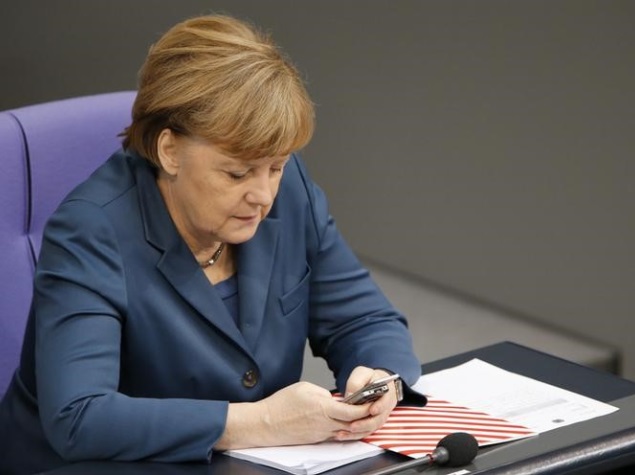
Germans need to overcome their traditional fear of the large-scale collection of personal data by companies and instead embrace its opportunities or risk being marginalised in the global economy, Chancellor Angela Merkel said on Tuesday.
In a marked shift in tone by Germany, one of the most vocal critics of the practices of U.S. web giants such as Google, Merkel urged the so-called Mittelstand of family-owned companies in particular not to be left behind.
"As anything but a digital native, rather in the best case a beginner digital migrant, I know what it means to have to adapt to this new world at an advanced stage of life," Merkel, 60, told a conference of business leaders in Berlin.
Mittelstand companies, the backbone of Germany's economy, are often run by older family members whose offspring do not want to follow in their footsteps.
"Whoever sees data as a threat, whoever thinks about every piece of data in terms of what bad can be done with it, will not be able to take advantage of the opportunity of digitisation," Merkel told an audience that included Google's Executive Chairman Eric Schmidt.
Merkel stressed she was not only referring to the increasing web-connectedness of traditional industry, dubbed "Industrie 4.0" in Germany, but the gathering of individual data to create personalised products that is so controversial in Germany.
Many German citizens hold visceral fears about the risks of exposing data to governments or corporations, with memories still fresh of mass data collection and spying by the East German state security service, the Stasi.
Yet industry leaders ranging from banks to car makers to publishers like Axel Springer, itself a major critic of Google, are beginning to analyse their customer data in earnest to spot trends and secure their future.
"Many jobs will disappear because they can be replaced by machines," said Merkel. "But I'm convinced that many more jobs will be created through the value of data."
© Thomson Reuters 2015
Comments
Get your daily dose of tech news, reviews, and insights, in under 80 characters on Gadgets 360 Turbo. Connect with fellow tech lovers on our Forum. Follow us on X, Facebook, WhatsApp, Threads and Google News for instant updates. Catch all the action on our YouTube channel.
Related Stories



Advertisement
Follow Us




-

19:39
LIVE: Xiaomi 17T & Xiaomi TV FX Mini LED Series Launch | Get Closer to Every Detail -
04:26
Moto Buds 2 Review: Best TWS Under Rs. 3000? -
03:26
How To Apply For Driving Licence Online From Home? | Step-by-Step Guide 2026 -
05:58
Motorola Edge 70 Pro Review | Full Specs, Performance & Battery Test -
07:07
Moto g37 Power Review: Best Phone To Buy Under 25,000?
-
Instagram Plus: अब बिना Seen हुए देख सकेंगे Story, मिलेंगे कई नए फीचर्स
-
OnePlus Community Sale: स्मार्टफोन, टैबलेट और ईयरफोन्स पर भारी डिस्काउंट!
-
Xiaomi 17T vs Vivo X300 FE vs OnePlus 15: कौन बेहतर?
-
Infinix Smart 20 होने जा रहा लॉन्च, 5200mAh बैटरी, Helio G81 दमदार चिप, Rs 11,999 से होगा शुरू
-
Xiaomi Pad 8 हो गया महंगा! इतने रुपये बढ़ गई 9200mAh बैटरी वाले टैबलेट की कीमत
Advertisement
Popular on Gadgets
- Samsung Galaxy S26 Ultra
- Motorola Razr Fold
- ChatGPT
- OPPO Find N6
- Mobiles Under Rs. 40,000
- Vivo X300 Ultra
- Asus Zenbook S14
- iQOO 15
- Vivo X300 Pro
- Lenovo Yoga Slim 7i Aura Edition
- iQOO 15R
- Vivo X Fold 5
- Sony PlayStation 5
- HP OmniPad 12
- OnePlus Nord CE 6 Lite
- OnePlus Pad 4
- OPPO F33 Pro 5G
- Cryptocurrency
- HP OmniBook Ultra 14 (2026)
- iPhone 17
- Eureka Forbes AP 355 Room Air Purifier
- Latest Mobile Phones
- Compare Phones
Latest Gadgets
- Lava Bold N2 5G
- Motorola Edge 2026
- Honor X7e
- Huawei Nova 16 Ultra
- Huawei Nova 16 Pro
- Huawei Nova 16z
- Huawei Nova 16
- Itel Aqua
- Asus ExpertBook B5 Flip G2 (2026)
- Asus TUF 16 (2026)
- Asus Pad
- Poco Pad C1
- Amazfit Balance Ultra
- Amazfit Balance 3
- Sony Bravia 7II
- Lumio Vision 9 (2026)
- Acer Predator Atlas 8
- Asus ROG Ally
- IFB 1.5 Ton 3 Star Inverter Split AC (CI193GN22RGM3)
- IFB 2 Ton 3 Star Inverter Split AC (CI223GD32RGM3)

- About Us
- Sitemaps
- Feedback
- Archives
- Contact Us
- RSS
- Advertise
- Career
- Privacy Policy
- Ethics
- Editorial Policy
- Terms & Conditions
- Complaint Redressal
Download Our Apps
Available in Hindi
© Copyright Red Pixels Ventures Limited 2026. All rights reserved.